
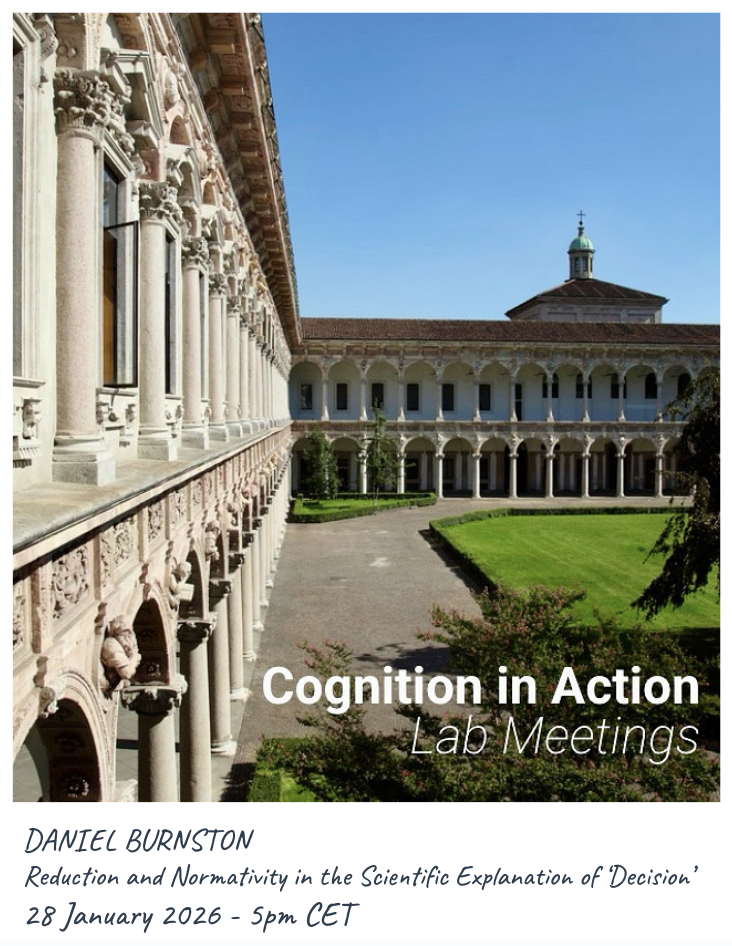
Speaker: Dan Burnston (Tulane University)
Dan Burnston is Associate Professor in the Philosophy Department at Tulane University, a faculty member in the Tulane Brain Institute, and the director of the Tulane Cognitive Studies Program. He is also co-managing editor of the Brains Blog.
Dan’s research focuses on a wide range of topics, most of which stem from an interest in how to functionally decompose complex cognitive and biological systems. He isalso interested in how scientists reason-what their concepts are like, how they employ representations of different kinds, and how these representations relate to explanation and scientific practice. Dan’s science interests include systems neuroscience, cognitive science, perceptual psychology, and molecular biology.
Title
Reduction and Normativity in the Scientific Explanation of ‘Decision’
Abstract
Philosophers have long resisted “reductive” explanations about the mind. Reductive explanations say that the nature of a mental property or process can be fully explained in terms of neuroscientific processes. There are many reasons, but two of the major ones are as follows. (1) The descriptions in psychology and neuroscience are non-commensurable; that is, one cannot derive facts about the mind from facts about the brain. (2) Mental kinds are inherently normative; they are claims about the right way to reason given a certain set of mental states (e.g., beliefs and preferences). Anti-reductionism is the consensus view in philosophy of mind.
In this talk, I argue against both (1) and (2), thus opening a way for reductive explanation of the key mental process of ‘decision’. With regards to (1), I outline a model of reduction based not on derivation, but on model-based explanation. Phenomenon P reduces to a model type M when M can explain the generalizations discovered about P. I show how neuroscientists are making progress at this type of reduction using accumulation to bound (AtB) models of decision. On these models, a decision is a neurally-implemented process of evidence accumulation to a threshold. I show how these models explain many important generalizations surrounding ‘decision’, as well as results that seem anomalous from an anti-reductionist perspective.
With regards to (2), I outline two ways in which normativity is inherent to, rather than inimical to, neuroscientific analysis. First, normative considerations are vital to determining when and how a mechanistic process works. That is, normative considerations are built into explaining how the mechanism works. Second, one can derive constraints on rational behavior from the nature of the decision-making process. As with other “bounded rationality” discourses, these construe behavior as optimal within constraints. Hence, we can reconstruct normative discourse (partially) using neuroscientific data.
Everyone interested is welcome to attend.
The meeting will be held in English.
Participation is strongly recommended for students of the Doctoral School in Philosophy and Human Sciences and for students of the Doctoral School “The Human Mind and its Explanations: Language, Brain, and Reasoning”.
Where: Online
When: 28/01/2026 – 17:00 CET
Attendance: Attendance is free and open to all, but registration is needed by email [angelica.kaufmann@unimi.it]